Tuesday, 23 July 2024

SPOTLIGHT ON: Kritika Soni


Ceramicist Kritika Soni with a series of her wall vessels. 
Image courtesy: Kritika Soni

As I waited for a friend at the Triveni Kala Sangam about a fortnight ago, it was purely by chance that I sauntered into an exhibition, titled 'Yuva Sambhav', then running at the venue's Shridharani Gallery. Organised by The Raza Foundation, it featured works by 12 young ceramic artists, specially chosen and curated by eminent ceramicist P R Daroz.

To use a cliché, it was a stunning revelation.

The exhibition showcased the very latest trends in the genre of ceramic arts. This is a genre that finds itself almost always overshadowed by the world of paintings, and to a small extent, of sculptures, and therefore, a complete exhibition dedicated to it was refreshing.


Ripple of Time, Stoneware, 50 X 70 in. (20 tiles), 2024, by Kritika Soni

It would be a disservice to the complex and labour-intensive genre of ceramics to immediately associate it with fine tableware, or perhaps, innovative, modern décor. It is as much a discipline of visual arts as painting and sculpture yet lingers on the sidelines as there are very few galleries dedicated to promoting it. The most notable exception is the Indian Ceramics Triennale, whose second edition was held in New Delhi from January 19 to March 31 this year.

As I walked through the exhibition slowly, gradually absorbing the cutting-edge work being done by contemporary artists in clay, I was overwhelmed by the sheer breadth of creativity on display, I wanted to know more about the artists and their practice. As I was instantly arrested by the works of Kritika Soni, I reached out to her for a detailed chat about her art. Here's what the New Delhi-based artist, who has a brand of handmade ceramic wall installation art called Kara Sabi, shared with me.

What is it about ceramics that drew you to the medium in the first place?

You are right... there is something about ceramics that drew me to this medium even though I wasn't trained to be a ceramicist. I studied textile design, first at Srishti Manipal Institute of Art, Design and Technology, Bangalore (2007-2011), and then at Chelsea College of Arts, London (2011-2013). Upon completing my education, I was working in the textile industry. But clay always appealed to me. So, it's a classic case of us planning something but destiny has something else in mind for us. I gave up working in textiles and switched to clay in 2016. But none of this was planned. There was nothing like 'I have to'. When I look back, I remember it as a moment of intuitive flow. 

So, that explains the little, textured details like a printed cloth on your works at the exhibition organised by The Raza Foundation...

Yes, that's true. No education ever goes to waste. As I have a background in textiles, it keeps appearing in some form or the other in my ceramic works. I have always appreciated tactile mediums as it also gives the artist more opportunity to explore and experiment, and ceramic allows that.


Details from Kritika Soni's works, from the set titled 'Broken and Beautiful', a set of 15 wall vessels, stoneware, 60 X 40 in., 2024

As a full-time practicing ceramicist, what would you say about the opportunities in the field dominated by paintings?

I have to say that I'm very new to the field — practicing for the past 6-7 years only — so my opinion would be that of a newbie. Having said that, I would add that the field is in transition. Ceramic art is very old, dating back to ancient times. Perhaps, because of its utility value over centuries, it came to be regarded as a craft. That continues to be the popular opinion about ceramics in India even though perceptions are changing, especially in bigger cities; my maximum orders are from Mumbai and Hyderabad. People are beginning to appreciate it for the art that it is. The mind shift is taking place.

How would you describe the ceramics scene today?

I think the newer generation of ceramic artists is highly experimental, as you must have realised in the exhibition. I know quite a few artists who are not formally trained in this medium. Lack of training, actually, works as an advantage for us as we do not know any rules to be able to break them! There are benefits of setting one's limits as you haven't been taught any!

That is why, exhibitions such as this one are a great opportunity. There are not very many platforms dedicated to ceramics, so when a prestigious foundation hosts an exhibition only for ceramics, it is a great honour.

Any ceramic artists whose works you follow or look up to?

I prefer experimental work and therefore, some artists with whose works my aesthetic sensibility can relate to include P R Daroz [the curator of the 'Yuva Sambhav' show], Vinod Daroz, and Vineet Kacker, to name a few. It is exciting to be able to understand that each one has their own distinct way of expressing themselves through the same lump of clay.


ENDS


Sunday, 23 June 2024

 SPOTLIGHT ON: Ompal Sansanwal


When eminent New Delhi-based artist Ompal Sansanwal ended his 15-year hibernation with a solo show, held at the Bikaner House in New Delhi in April-May this year, it seemed like a great opportunity to finally see a full exhibition in person, of the works of an artist I've admired for long.

The exhibition, 'Jiva', featuring 60 paintings of trees and the diverse ecosystem they nurture, was curated by art historian Uma Nair and was presented by Sanya Malik's Black Cube gallery. The trees sprouted all over the venue through canvases in bright, solid colours such as yellow, blue and red. On some canvases, there were massive trees cradling stories and civilisations, while on some others, well-known stories were expressed through perpetually expanding roots and branches of trees, that not only defined the landscape but also the bodies of the figures. 


The most arresting of these was the tree-Nataraja in bright yellow and red, which incidentally, was also the latest work from Sansanwal's repertoire. Uma Nair, the curator of the show, said about this painting: "The Nataraja created with branches of the banyan tree is like a lattice of divinity bathed in the light of Bhakti."

Sansanwal works with pen and ink, watercolour and a detailed crosshatching technique using acrylic paint on canvas. He has exhibited his works in several solo and group exhibitions since 1995 and is a recipient of the Lalit Kala Akademi's National Award (2002) and Rajasthan Lalit Kala Akademi's award in 1991.

While it was difficult not to be overwhelmed with the effulgence of spell-binding paintings all around, another one that literally seemed to draw the viewers to itself was the pen and ink rendition of Krishna balancing the Govardhan hill on his little finger while the population of his native Mathura huddles underneath to escape fierce rain and thunderstorm; the latter is depicted with the solid blue background in acrylic, the shade hovering between cerulean and azure.


It's not a surprise that the artist has undertaken several trips to only soak in nature, prominent among which remain his treks through the Himalayas and frequent visits to Bharatpur bird sanctuary, amongst others. 

While the theme of nature, and more specifically, the tree of life, is a very evident summation of his oeuvre, Sansanwal surprises by adroitly amalgamating mythological and other stories in the narrative. It can be likened to coming together of the important strands in his trajectory as an artist — the affinity for nature and the mythological stories that he grew up on, both represented as an organic whole through intricate, dexterous drawing, detailing and crosshatching.

Here's a Q&A that I was fortunate to have with the senior artist on his oeuvre and his journey.

It's so great to have a full-fledged solo show of yours in New Delhi after so long. Why this hibernation?

I don't paint for a show. I paint without any goal and do a show when I feel I'm ready for it. The struggle may be hard and long, but it is like trekking with a heavy rucksack on your back. It is tiring but after two days of walking and walking, suddenly a point comes when you see the snowy mountains... only snow, no human being around. That sudden turn washes off all your fatigue and rejuvenates you like nothing else can.

The plethora of trees, and nature in general, in your canvases shows your close affinity for nature. Is there some deep-seated reason for your preference?

I grew up in a village called Katwariya Sarai — where now stands IIT Delhi — which at that time was about fields and jungles. In primary school, we would study under a tree and the entire day was spent running amongst trees, climbing up the branches, resting under the shade, collecting wild berries... we would spend almost the entire day outside. I remember the evenings spent with my mother listening to mythological stories, which as we all know, are replete with man's close connect with nature. So, years later, when I joined the Delhi College of Art, nature was an integral part of my being. Some more years later, I realized the pull of nature on me and went back to it.

As nature kept pulling me towards it, I gradually realized that I had found my visual language. So, no matter what you learn at an art school — the skills, western techniques, various experimentations, etc., you keep going back to your roots. My roots finally gave me the language that is mine. Now, no matter what theme I may pick up, it is expressed in my distinct language.

Is there any artist whose oeuvre has influenced you profoundly?

My college senior Neeraj Goswami influenced my art, often inadvertently, from which I had to practically wean myself away to be able to chart my own independent journey. Among global greats, Vincent van Gogh, the 19th century Post-Impressionist Dutch painter, has been a profound influence. Till about the third year in college, I didn't quite like realism but then I read Lust for Life [the biographical novel by Irving Stone on van Gogh's life] and was totally converted. Not just his style of painting but his life itself became a huge source of inspiration for me. 


***


Friday, 19 January 2024

Where are our children gone?


The spectacular winter this season has made me fall in love with Delhi Metro, twenty-one years after the entire city fell in love with it. But this write-up is not about this God-sent Mass Rapid Transit System but a rather unusual experience that I had there, which got me thinking. 

A few evenings back, as I exited the Nehru Place station, I noticed a senior lady passenger walking ahead of me, with a great deal of struggle. She was finding it difficult to keep her balance amid the people rushing around her, most of them breezing past with their heads bent on their mobile phones, totally unmindful of where or what they were walking into. I slowed down to see if she needed any help. She did. As I approached her, she smiled, aware of my intent and completely willing to be helped.

Just at that moment, I felt I was looking at a child's face. A face that lights up with relief when someone tries to help. A moment when the child spontaneously raises its arm towards the adult who has come to its rescue. 

This lady, whose name I subsequently asked but would rather skip mentioning, instinctively said, 'Beta!'

I took her bags, held her arm and we started walking slowly towards the exit. She was embarrassed at being helped. I assured her that I did the same with my mother and she shouldn't feel bad about it. She smiled, pressed my arm firmly and eased up a bit. And she started talking, giving me explanations even when I had not asked for any.  That's when I realised that she was not embarrassed at being helped, but at what she thought I must be thinking — that her family didn't really care about her. I had said or done nothing to elicit that train of explanations but she was clearly embarrassed at 'being caught' walking alone and with a great deal of struggle.

Her attire told me that she had children living in the U.S. and her speech indicated that she had been to the U.S. multiple times visiting them. And it turned out to be right. She continued: "I'm not generally in this position. I had gone visiting my sister in Karol Bagh and today, surprisingly, I didn't manage to get an Uber or an Ola for way back home. Otherwise, I don't have to struggle like this. If my daughter learns of this, she is going to be very mad." The daughter lives in some town of California, whose name I now forget.  By the time we reached the road outside the station, she had a tinge of pathos in her voice. "My husband passed away six years ago. Since then, I'm alone. I have only one child — my daughter — and she is so far away. She keeps a check on me and gets very angry if I don't take care of myself. " 

I was beginning to be seriously affected by this lady's talk as my relation with her had by now progressed from being a total stranger lending a hand for a moment to someone invited into the private life of a senior citizen who was at pains to hide her daily struggle and yet was in denial that her life could have been better had her child done something about it. 

I don't know what her daughter should have done and I'm no judge on how people want to live their lives. May be, the lady didn't want to go and live with her daughter in the U.S.; may be the daughter had pleaded with the mother to be with her but the mother didn't want for various plausible reasons; may be, may be...

She continued, "If you live nearby will you come and have dinner with me some time? I know you must have a life with family, etc., but do think of spending some time with me. I'm alone and almost always eat my food alone. It will be nice to have your company."

The rest of her conversation went on in the same vein. She was a pleasant person with a sweet voice but her story affected me. My first reaction to any situation got the better of me and I felt the chills — I wouldn't want to be in that situation ever. Of being so alone, so completely alone that just one smile, one helping hand can trigger an emotional response. I felt sorry for this lady, who was being so valiant in her loneliness, so upright and living it up with pride.

But what it made me wonder about was the question about children. They will grow up and go away and build their lives, which they must, but why is old age so fragile that it must be lived alone with pangs of not having one's own nearby to share daily doses of happiness and tribulations? What can children do? Should they give up their lives? Most certainly not. But then, what about parents? Must they publicly feel proud of their children having made it big in the U.S., and yet silently suffer inside?  

I have been thinking of all this since the encounter and now I'm feeling alarmed that I have come across so many such lonely elders in the recent past, in whichever city I have visited lately. Where are our children gone? Why should the elderly be so helpless, physically and emotionally? May be, there are no final answers to resolve this situation. Is there something that the society needs to do, may be some course correction? Or that's the way civilisation is meant to progress? Too many questions, too few answers...


Image copyright: © <a href='https://www.123rf.com/profile_kotenko'>kotenko</a>, <a href='https://www.123rf.com/free-images/'>123RF Free Images</a>


Monday, 10 July 2023

 The Rise and Rise of Ganesh Pyne


I have been following the steady rise of the market value of Ganesh Pyne's works over the past two-three years, and have been pleased at what I'm noticing. At the recent Saffronart's online auction on June 28-29, his works shone brightly. I have written a detailed analysis on this subject in a column at Hans India's Bizz Buzz on July 8 (the e-paper version above), which can be read here

For those interested in a quick recap of some of Pyne's top-selling works recently, here's a lowdown:

1. Slumberland, 1971, tempera on canvas laid on card, Sotheby's auction, March 2022, Rs 4 crore ($529,200)

2. Untitled, 1981, tempera on mount board, Sotheby's auction, October 2022, Rs 3.5 crore approx. (£340,200)

3. The Animal, 1972, tempera on canvas laid on card, Christie's auction, September 2020, Rs 3.3 crore approx. ($400,000)

4. Before the Pillar, 1972, tempera on canvas laid on card, Pundole's auction, September 2022, Rs 3 crore

5. Untitled (Laxmi Emerging from the Ocean), circa late 1960s, tempera on canvas, Christie's auction, December 2016, Rs 2.37 crore

6. Woman Sowing, circa 1970s, tempera on canvas pasted on paper, Saffronart auction, October 2021, Rs 2.04 crore, ($275,676)

7. The Window, 1997, tempera on canvas, Saffronart auction, July 2021, Rs 1.01 crore ($150,000).


Wednesday, 24 May 2023

Why should India's 'dubious distinction' bother Pakistan?


(This is a screenshot of Rafia Zakaria's column in the Dawn, May 24, 2023)

Who is Rafia Zakaria?

A nobody, whose Wikipedia profile calls her a Pakistani-American attorney, feminist, journalist, and author. That itself probably entitles her to talk baloney on things she has no understanding about. Like her opinion on the population of India.

This morning, she enlightened the world about what she thinks of India's 'dubious milestone' of becoming the most populous country in the world, in her column in the Pakistani newspaper Dawn. Titled 'Too many people...', the column holds forth on how India failed in containing its numbers, while China did. It also rubs in the glee the author derives over this 'dubious milestone' of India by quoting how the German news magazine Der Spiegel made fun of this fact through an insinuating cartoon.

All this is quite alright and in the domain of public debate, but what gives Ms Zakaria the right to spew such disgusting calumny over a topic she clearly has no depth to write about? One has to only read a few lines of her column to know how specious and superficial her writing is. As a journalist, she has produced a terrible copy that did not deserve publication.

I would like to ask Ms Zakaria if she is aware of what is happening in her country of origin? Any number of words would prove inadequate to describe the totally despicable state of affairs in Pakistan currently. Ms Zakaria should be advised to pick up her pen for worthier causes focussing on Pakistan, instead of wasting precious digital space on the neighbour her country so loves to revile. If she is suffering from lack of inspiration, she only has to read the very newspaper that has published her laughable column. The Dawn has ample ideas for her to write on, matters that she may have better understanding of, such as the ongoing political drama around Imran Khan and PTI, also the ongoing rapid decline of economy, the ongoing plunge of the Pakistani rupee, etc., etc.

In other ideas, she could also write on how the world has stopped listening to Pakistan's hue and cry over Kashmir. Or, on its Faustian capacity to please its big brother only to be able to pursue its favourite pleasure of terrorism? 

How about the burgeoning population of Pakistan as a topic? It is, after all, as 'dubious' a 'milestone' as India's population given the size and 'prosperity' of Pakistan. Or, how about writing on the very limited choices of life this huge population of Pakistan has, given the state of polity and economy in the country?

That would give you, Ms Zakaria, a more profound shot at writing than the topic of India's miseries. Leave that to the Indians, please.


Friday, 23 September 2022

KNMA’s Somnath Hore retrospective closes on 30 September; time to give the master his due


All images from the KNMA exhibition, 'Somnath Hore | Birth of a White Rose'

In the month of May, I had the good fortune of spending a couple of hours at the Kiran Nadar Museum of Art (KNMA) in Saket, New Delhi, browsing through an exhibition at leisure that deserved nothing less. The exhibition was, 'Somnath Hore | Birth of a White Rose'. I wrote a piece on it for the Bizz Buzz supplement of The Hans India newspaper, which I'm reproducing in parts below. It can also be accessed in entirety here
Ever since I visited the exhibition, I have exhorted all the art-sensitive people I know in my circle to visit it definitely, or else, they would miss out on one of the most seminal exhibitions of modern Indian art. For anyone who has heard of Somnath Hore but doesn't know about this master's work well enough, there is still time to check out the exhibition that gets over on 30 September. If anyone needs any entry point into it, my write-up for Bizz Buzz would be of help (some excerpts below).
'It's time to give due recognition to Somnath Hore for his masterpieces'
... I would like to bring focus on the exhibition, 'Somnath Hore | Birth of a White Rose', currently on view at the Kiran Nadar Museum of Art (KNMA) in Saket, New Delhi. What makes this show the most important of the entire year, perhaps, is its potential to catapult the oeuvre of this seminal Indian modernist — currently not as well-known outside the art circles as he should be — to the heights he truly deserves.
Hore (1921-2006) is celebrated well within the artistic-academic circles, but in light of his outstanding contributions to Indian modern art, he deserves to be feted equally well by the market; and with as much fanfare as has been accorded to his contemporaries such as S. H. Raza, M. F. Husain, F. N. Souza, and V. S. Gaitonde to name a few.


The importance of a retrospective
What can an exhibition do to an artist's career, a layman may rightfully ask. Several factors go into the making of the complex rigmarole that makes and builds an artist's career, helping him succeed and rise above the ordinary. One important factor amongst these is the role played by a museum/ gallery in building the right interest in an artist's work, an interest that his/ her art truly deserves (and not due to any media frenzy). Curated by Roobina Karode, the Somnath Hore retrospective needs only one comprehensive visit to prove to the viewer the excellent and rigorous scholarship that has gone behind this vast show on the artist pedagogue, whose practice coursed the routes of social realism as well as humanistic modernism, mentoring generations of students and artists. 
Named after Hore's eponymous work that won him the prestigious National Award of the Lalit Kala Akademi in 1962, the exhibition covers a huge arc of the artist's career, from his earliest years to the last, presenting a humungous range of works — from prints and printing plates to painting and bronze sculptures. 

It has been seen that when an exhibition backed by such scholarship brings focus on an important artist such as Hore, and removes cobwebs from the understanding of his work by common admirers of art, a domino effect of appreciation is put in motion, which eventually leads to a nod by the global market too.
The most recent case of renewed appreciation of an artist's worth by a market has been that of V. S. Gaitonde (1924-2001), one of whose works currently holds the record of the most expensive Indian painting — it is an Untitled oil on canvas by Gaitonde, made in 1969, which was sold for Rs 42 crore in February this year at an auction by Pundole's in Mumbai.
An important artist from Bombay who was highly regarded for charting an individual course of abstractionism, and who was also associated with the seminal Progressive Artists' Group, Gaitonde did not enjoy the spotlight in his lifetime like his art is doing now, even though he was admired and collected by true connoisseurs then. He came under global focus most prominently after his landmark retrospective was hosted by the prestigious Guggenheim Museum in New York from October 2014 to February 2015. Gaitonde was pushed into the very centre of the spotlight, where he continues to shine. 
As an admirer of art and someone perceptive to the intellectual perspicacity of an artist to his environment, and the effort required to translate all that he sees around him in his works, this writer sincerely hopes that the current KNMA show will prove for Somnath Hore what the Guggenheim show did for Gaitonde.


The significance of Somnath Hore
Somnath Hore, who would have been 100 last year, was born in Chittagong in present-day Bangladesh. Exploration of the human suffering through his art remained his lifelong leitmotif. His coming into his own as an artist coincided with some epochal events in the Indian subcontinent — the Bengal Famine of 1943, the Tebhaga peasant uprising of 1946, the Partition and the consequent violence — which deeply affected his art, leaving an impression for a lifetime.
Like many young men of his times, including the artist Chittaprosad, Hore too joined the Communist Party for a while, and his early sketches of human suffering appeared in the party's journals. Though he dabbled in a variety of media, he is best remembered for his prints, a genre of art that he contributed to immensely, setting up the printmaking department at Delhi Polytechnic and later heading the same at Kala Bhavana at Santiniketan. A novel style that he essayed was visible in his Wounds series of works, where he foregrounded the suffering of the deprived through slashes and lacerations on paper. 


Somnath Hore's art (along with that of Chittaprosad's) is a grim reminder of the mammoth human tragedies — engineered by those in power — that humanity has a way of forgetting before long. His art also emphasises the need for art to portray all that exists, beyond the beautiful and the aesthetic, and be the voice of the people when they find none. His art is like an important document that only gets more valuable with each passing era.


A quick scan of the top auctions reveals that not many Somnath Hore works have been offered at sales, but those that have been offered, have almost always been sold for way beyond the highest estimate. Some of his top works sold at auctions include an Untitled bronze (1988) of a slain animal at Sotheby's in 2007 for $60,000 (approx. Rs 46 lakh at current conversion rates), and Draupadi and Shakuni, another bronze (1992), sold by Christie's in 2017 for $118,750 (approx. Rs 92 lakh at current rates). There's no reason why Somnath Hore cannot achieve greater prices at the market.


***


Saturday, 18 June 2022

Hindi Diaries / 1. Why do we love to hate Hindi?


This is a question that has bogged me since ancient times. Since as long as I can remember. Since the time I was a student at Carmel Convent School, Bhopal, where the insane emphasis on speaking English is the reason that almost all its graduates waltz through this department like the early morning breeze over tender, green ears of wheat in a field.

I have had discussions on this question at home umpteen times, especially since a certain variety of language Nazis became part of our large, extended family through marriage and started measuring familial relationships on the weighing scale of languages deliberately not known. Confused about what that means? Well, you will discover gradually as you read along.

Going back to Carmel, one of the best things that I remember about my school is its equally insane emphasis on Hindi. Teachers and newly-minted parents of this age would be shocked to know that it was not just English, but Hindi and Sanskrit too which were taught with the zeal of a missionary by, well, the Christian missionaries who ran the school (pun, intended!).

One of my earliest favourite teachers was a Christian nun whose mother tongue was Malayalam, and who taught Hindi when I was in Class V, right up till Class VIII, if I remember correctly. She was born and brought up in Kerala but had acquired excellent command over Hindi — and professional expertise too — after shifting to Madhya Pradesh. Within a few years, she had gained command over the most arduous of Hindi muhavaras and lokoktees (idioms and proverbs). The most endearing part of her speech was the slight, barely-noticeable Malayali inflection at the end of her Hindi sentences, that made it totally charming.

I regret I cannot recall this dear teacher's name just yet though I remember her face distinctly, standing at the head of the class with a book in one hand, and the fingers of the other gently pressing the words in air, as if playing an imaginary tune.

She is the one I remembered when I sat down to prepare questions for Daisy Rockwell (#Daisy Rockwell) , the most famous speaker of Hindi at this moment, for an interview. Those who don't follow books and authors wouldn't know who she is but is well worth knowing about. Rockwell is the American translator of the Hindi novel, Ret Samadhi by Geetanjali Shree (#Geetanjali Shree), which in its English avatar, the Tomb of Sand, won the International Booker Prize 2022 on 26 May in London. (I had spoken to Geetanjali Shree when the book had appeared in the longlist in March, and to Daisy Rockwell when it eventually won the prize in May (These stories / interview can be read here, here and here). 

It may sound cheesy to say so, but one often gets reviled for calling spade a spade. The truth is that Hindi is suddenly feeling a current of positivity thanks to that uniquely Indian aspiration — a validation from the West. For the language, this validation has come as a double whammy in the form of the International Booker and Daisy Rockwell.

"Two angrez entities rooting for it??!! There must be something in it!!" I could almost hear a lot of pseudo-angrezs of India say this (if at all they would have head of this news in the first place, that is...)

And so, the occasion became ripe enough for me to finally seek an answer to the question that has troubled me for centuries. Why do you have to hate Hindi to know/ speak/ write good English?

I have made a living out of writing in English for more than two decades now and feel vainglorious in admitting that I happen to know it well enough to have survived this tough industry (though not as well as some of my peers). Yet, I didn't have to hate Hindi and Sanskrit to be good at English. My Hindi and Sanskrit were equally good in school, and mercifully, Hindi continues to be as good as English. Ever since leaving school, when I stopped studying Hindi academically, I have remained in very active touch with the language as organically as possible, without making any extra effort at all, and am proud of the Hindi books in my collection as I'm of the English books.

How does one, then, make an extra effort to not know a language, when it is being thrown about your ears all day long? How can you not pick up Hindi if living in Delhi, or not pick up Bangla in Calcutta, Telugu in Hyderabad, or Kannada in Bangalore? You really have to be living in an insulated, gated community (again, pun intended!) to be sheathed against a language in such a way.

As far as common scientific knowledge goes, language as an individual's attribute is controlled by a specific part of the brain, which sadly for the pseudos, doesn't discriminate between  languages. If that part of your brain is highly active, you will be good at languages, no matter which language you choose. If not, you would not be so proficient in languages.

Many areas of the brain such as Broca's area, Wernicke's area, Angular gyrus, and perhaps a few others, work in tandem to decide a person's ability to process a language. That is what I have known.

I wonder what part of brain helps obliterate Hindi altogether while helping one absorb English? I think this must be a sui generis component of the brain because English has not worked in such conflicted ways with any other language in the world.

So, a big chunk of Gen Now in my big circle of family, friends and acquaintances is growing up shutting its ears to the local language of the Indian city they are being raised in. They only English, unfortunately, and only as a shallow multi-media import from the US. How can one gloat on one's limited knowledge when one's proficiency in multiple languages is an asset any day?

I remember a joke that was shared by an American acquaintance whom I used to know a decade ago. He was Bruno Blumenfeld who had chaperoned the IVLP (International Visitors Leadership Program) group of four of which I was a part, on our month-long tour of the US in 2012, courtesy the Department of State. The five of us — Anita Naidu, Bruno, Renu Oberoi, Sukhesh Arora, and I — were talking about languages as Bruno believed (and rightly so) that Indians were a multi-lingual people and every Indian he had met knew at least 2-3 languages, if not more.

He asked us: "What do you call a person who can speak many languages?"

We answereed: "Polyglot!"

Bruno: "And a person who knows two languages?"

Us: "Bilingual"

Bruno: "A person who knows one language?"

We looked at each other.

Bruno: "American!"

A generation of Indian parents so badly wants to live the American dream without having managed to go to the US (that's another aspirational story, by the way), that they have shuttered out every other language from the universe of their children. The consequences of this misplaced elitism, good or bad, will become evident only in the years to come, but what's the harm in knowing a language for which one doesn't have to make any effort, or investment, or clear an exam, except for keeping their ears open?

I know of people who have forbidden family members from speaking in Hindi at all with their growing children. It's ridiculous how it has become the community's responsibility to prevent the young ones from being exposed to Hindi, not even by mistake. 

I'm not even going into the debate of Hindi being imposed on the rest of the country as the national language. I think promoters of Hindi must first deal with the apathy towards the language by its own native speakers. What's the point of forcing it down the throat of non-Hindi speakers when those born in the milieu of the language are shunning it like an infection?

Frankly, in my personal range of acquaintances, all those who have eschewed Hindi to be able to speak better English (or any English at all) are none the wiser for it. At best, their English remains sketchy, colloquial and a sham that betrays not only their farcical love for America but also a studied indifference towards their own reality. They speak SEO English — they know the catch / key words and phrases well enough to retch out glib sentences with confidence, however shallow the entire content may be. It's almost like the din of nondescript narration one hears while travelling in Delhi Metro. [Sshh! They watch Bollywood movies and fully understand too.]

Why do native speakers of Hindi love to hate it so much? Why don't Bengali, Malayalam, Tamil, Marathi and other language speakers not fight shy of their mother tongue even when they are brilliant in English?

There are several other issues that plague Hindi's relation with its own native speakers, some of which get addressed every once in a while, by creative individuals through their writings, songs, films, etc. But that's another story, or stories, perhaps.

The biggest crisis of Hindi is not that the non-Hindi India abhors it. It's the hostility and loathing it elicits from those born in it that is most disheartening. Geetanjali Shree deserves another monumental prize for restoring at least some dignity to this highly misunderstood language. 


Thursday, 9 June 2022

Reading Dalpat Chauhan

I think of Preetha (#Preetha) when I sit down to write this as I haven't come across a more receptive interlocutor when it comes to discussing books in my entire life. How I miss the days at Mail Today when we would spend hours discussing books beyond what was officially covered by the newspaper for its books pages. And how often, I would goad dearest Priyanka (#Priyanka) to join us, whenever she would manage to take some time out of her busy editing/ writing schedule.

So, this is for you, Preetha and Priyanka, and how I wish we could actually sit down and discuss this in person some day.

For various reasons, I had not read a book fresh-off-the-press in a long while. I guess you read freshly produced stuff regularly only when 'covering' books for a newspaper/ magazine. So, while I continued to read as is one's wont, I was actually reading what I wanted to. Only recently did I lay my hands on a freshly-published book, Vultures by veteran Gujarati writer, Dalpat Chauhan. It's the English translation of his 1991 Gujarati book, Gidh, done lovingly by Hemang Ashwinkumar.

After reading the book, I spoke to the author. I had only one question in mind though we ended up talking for nearly two hours. The only question I wanted to ask him was: Why is he identified and promoted as a Dalit writer? Doesn't it defeat the very purpose of democraticising life, when even literature is getting classified as such? 

His honest answer was not only disarming but also a chilling reminder that securing and safeguarding rights in the country's Constitution only goes that far. He said: "Yes, it defeats the purpose. But who will write about us, if we don't? Our stories, our lives, our struggles, when told by one among us, have a ring of authenticity. An outsider can never translate that authenticity without experiencing it. I have lived what I write. Therefore the need to be identified as a Dalit writer."

Chauhan, 82 and based in Ahmedabad, began writing after he retired from a job with the Gujarat government, and has written about 25 books so far — novels, short stories and plays, all throwing light on the lives of Dalits. 

Vultures or Gidh is based on a real story of the murder of a Dalit boy by Rajput landlords in Kodaram village in Gujarat in 1964, for his involvement with an upper caste girl — a familiar tale that could be placed anywhere in India. Chauhan recreates this story through Iso, a young boy from the community of tanners, who, as the book jacket says, 'faces the brutal sword of caste patriarchy.'

It's a touching tale, told with great emotion by Chauhan, that I would recommend all my like-minded friends to pick up if looking for a thought-provoking read.

As I shut the back flap of the book on its last page, I felt very heavy in heart. The events described in the book had taken place in 1964, a time so long ago from our current reality, yet seemingly so close today especially when there is tremendous polarisation in our daily lives. We are removing the dirt from old fissures that had remained so neatly buried all these years... how can we expect new realisation to dawn on us at such times? 

I would rather use the words of Dr Bhimrao Ambedkar to sum up my sentiment, from his speech that appears at the opening of the book: 

'As experience proves, rights are protected not by law but by the social and moral conscience of society. If social conscience is such that it is prepared to recognize the rights which law chooses to enact, laws will be safe and secure. But if the fundamental rights are opposed by the community, now Law, no Parliament, no Judiciary can guarantee them in the real sense of the word.'

As a community, we are yet to grow up to be worthy of our own Constitution.


Friday, 9 July 2021

 An Outsider In The City

© Archana Khare Ghose

This January, I completed 20 years in Delhi. It was a landmark that I barely noticed myself simply because one gets so caught up with the daily activities of life, especially when one is as old as I am. Yet, its importance was never lost on me. That’s because, even after a mighty two decades, I still feel like an outsider. 


A few days back, I finally took up pen and paper to give shape to a personal project that has been within the faintly lighted corners of my heart for a long, long time. I finally decided to bring it out in the open, under the sunlight, so that I mentally process my journey for myself, and in the bargain, perhaps, find kindred spirit who would identify with it. The aim is only to write and perhaps, be read, even if by only one person who has had a story similar to mine. 


Part I/ Building A Life in Delhi – The Beginnings


The ways and people of the city I have called home for the past 20 years surprise me ever so often — as if I am still ‘fresh off the boat,’ ready to be startled by the slightest of sounds, barest of sights, most common place movements…


I still remember it so clearly even now. It was a chilly evening of January 5, 2001, when I called up the secretary of my would-be editor at Hindustan Times to find out the status of my transfer from HT Bhopal to Delhi. I didn’t carry a cell phone then (not many did, in fact), and I had been asked to call up the editor’s office at 5 pm to know if the transfer had been approved by the management and the editor. 


I had settled near a PCO (short for Public Call Office, for people like my son and his generation who are not likely to know what it was) well before time, with fingers crossed and heart pounding. It was one of the many PCOs at the Chanakya Cinema area where I was ambling aimlessly, or rather enjoying the Delhi winter. In trepidation of what that phone call had in store for me, I had already treated myself to some really unhealthy but extremely tasty chow mein. 


Working for a national daily in the nation’s capital was a wish I had nurtured strongly in my heart since college days — strong enough to have refused the offer of a teaching position in Barkatullah University as I had topped in the master’s programme with marks that did not have a precedence! (This sounds so nauseatingly vain! Yet, the truth must be told to highlight the importance of my little wish that I was hoping would be fulfilled that January evening). When I had refused to take up the teaching position, the professors offering it were so shocked and disappointed, they called up my father. He tried to reason (meekly, as he knew the outcome), telling me that a future professorship wasn’t a bad idea and would leave me with lots of time to write… I refused to speak to him for a week and cried buckets… Now, I look back and tell myself: ‘Yes! This is what I was crying buckets for!!’


Well, the most important call was made and I was told I was supposed to join in a week’s time and no later. 

And my life changed. 

For good or for worse… the jury is still out on that…


Back then, the biggest happiness was that I had landed in the profession where I had always wanted to. I had never harboured dreams of going to Delhi. The dream was always about working at a national daily and building my life as a journalist/ writer. If Delhi weren’t the mecca of journalism in India, I wouldn’t have come here, I would have gone wherever that mecca would have been. 


Ever since, whenever I have thought about why I have continued to feel like an outsider in Delhi, I have always known the big difference — I took to Delhi journalism like fish to water, but not to the city. There are several reasons, why. 


A big one that I can recall is perhaps the welcome I received at my workplace on Day 1. It is still fresh, again, like many other memories one would rather forget, but one doesn’t! It’s good that these memories don’t faint over the years because they ultimately build you up, make you the person you are. 


That’s what I’m going to write on next. 

(The image above is of the arches at the Feroze Shah Kotla, the 14th century fortress built by Feroze Shah Tughlaq, the Sultan of Delhi from 1351-1388. It lies on the present-day Bahadur Shah Marg, a stone's throw away from The Times of India office). 

Monday, 23 September 2019

Japani Shyam: Her Father's Daughter


It's not unusual for children to pursue the same profession as their parents, specially if the latter are highly successful and have made a mark globally. What's unusual is a career option becoming a legacy to shoulder under tremendous pressure and social vigil, because the parent has passed away prematurely.
Does the legacy, then, become a burden? Does it affect the child's own growth as a professional? Do such children succumb to the pressure and end up becoming could-have-beens? It has happened quite often in the film industry, examples too well-known to quote here.
I had these questions popping in my head as I prepared for a meeting with Japani Shyam. Even those who don't know her but know enough about the art world know about her — the daughter of India's most famous tribal artist, who earned global fame in his short life and whose works continue to be placed on the same pedestal as those by top-notch Modern and Contemporary artists.
Jangarh Singh Shyam, the Gond tribal artist, was famously 'discovered' by another legend, J. Swaminathan and brought from his village in Mandla district of Madhya Pradesh to the state capital Bhopal to embark on a career that took him all over the world. He is the gold standard in Indian tribal art of our times.
Being his daughter is Japani's biggest identity, yet in all the years since her father's passing — she had just stepped into teenage then — she has slowly and gradually carved a niche for herself. She was interested in her father's work right since she could remember. She shared that she enjoyed watching him work, and doing a big of painting herself. But the tragedy that struck Shyam's family — his wife Nankusia and son Mayank are also well-known artists — left young Japani with a very mature question — how to carry on painting in "Jangarh Kalam," a style developed by her father, yet not become do something distinct, "and make my own name?"
"I realised early on that my father's legacy was too big. Yet, I wanted to do something that would not be a copy of what he did. He wouldn't have wanted me to be a copy artist," Japani, now 30, shared with me in a recent meeting in Bhopal, where she is based. Her solo show is currently on view at Shobha Bhatia's Gallerie Ganesha in New Delhi.
Japani is a fabulous artist and makes canvases that are a delight to connoisseurs, and visually mesmerising to novices interested in learning about art.
I wrote a piece on Japani and her current solo for www.blouinartinfo.com that can be read here
Images of her works, pasted below, give ample idea of the talented artist who knows how to blend her Gond heritage with her city upbringing.


All works acrylic on canvas. All images courtesy Gallerie Ganesha.


Thursday, 19 September 2019

Bright Colours From Sabia's World


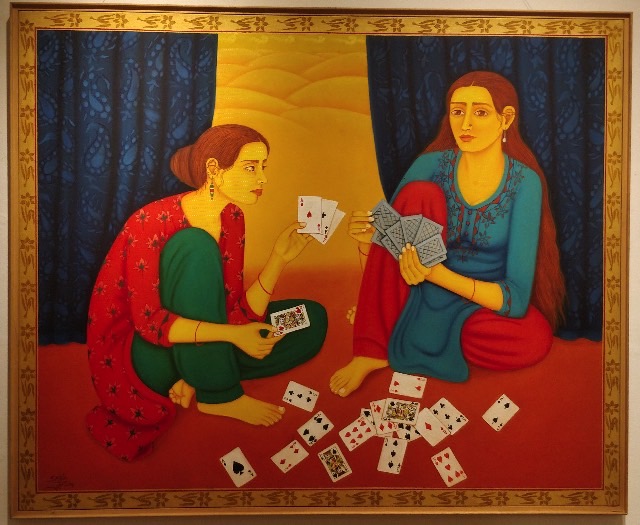
This lovely oil-on-canvas above, a triptych, is by New Delhi-based artist, Sabia. In the picture, she is seen with our common friend, artist Rahim Mirza.
I had gone to meet Rahim at India Habitat Centre the other afternoon. We met outside the Visual Arts Gallery. I had no plans to walk in to the gallery just then, a little later, perhaps, to check out any show that may be running there. But with a particularly muggy day, I was more interested in heading towards our lunch destination, Eatopia.
Just then, the corner of my eye caught a blaze of colours at the far end of the gallery. It was this canvas, at the opposite end, that forced me to stop. And then, Rahim told me about Sabia and her show.
We returned soon after lunch to let Rahim introduce me to the artist and the fabulous colours and people of her world, whom she transports beautifully on her canvas. I'm pasting below some truly stunning works by Sabia (she goes by the mononym) and let those do the talking about their creator.
Basic details: Sabia paints in oil, is a free-willed, independent thinking painter who learnt early on that she would rather focus on painting than trying to be in good books of the movers and shakers of Delhi's art world, most of her shows are sold out (obviously!), wears her Chandni Chowk upbringing with pride, and gives it life on her canvases too. Her "Ghalib" series, especially, is a veritable trip to the undisturbed bylanes of old Delhi.
Check out her works below.
I also wrote a review of the show for Blouin Artinfo, which you can read here.


An untitled oil on canvas from Sabia's "Ghalib" series, 84 x 84 inches.


An untitled oil on canvas from her "Game" series, 66 x 54 inches.


An untitled oil on canvas from her "One Hundred and Eight" series, 48 x 48 inches.


An untitled oil on canvas from her "One Hundred and Eight" series, 36 x 48 inches.